
English
Views: 0 Author: Site Editor Publish Time: 2021-09-14 Origin: Site


Three-jaw chucks are mainly used to process round parts, while four-jaw chucks are used to process square, square and eccentric parts.
Application occasions:
The three-jaw chuck is mainly used in finishing turning, grinding, rough turning using a universal indexing head and grinding, milling and other processing situations where invisible position accuracy is required.
Four-jaw chucks are mainly used in ordinary lathes, economical CNC lathes, grinders, milling machines, drilling machines and machine tool accessories, and indexing head rotary tables.
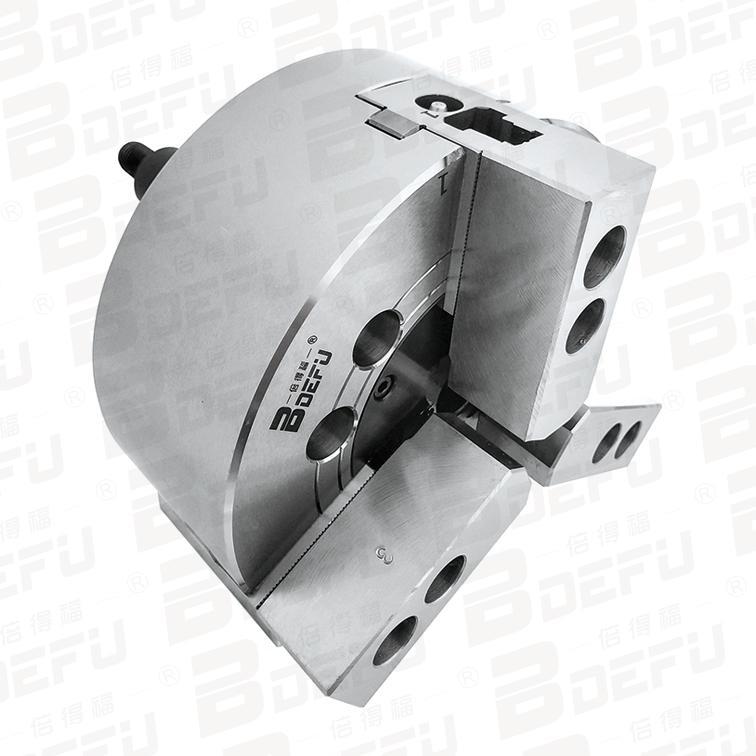
There are two types of jaws for four-jaw self-centering chucks, including integral jaws and separated jaws. The integral claw is a claw in which the base claw and the top claw are integrated. A pair of integral claws is divided into four positive claws and four reverse claws. A pair of separation claws only has four claws, and each claw is composed of a base claw and a top claw. Through the transformation of the top claw, the functions of the forward claw and the reverse claw are achieved.
In addition, soft claws can be provided according to user requirements. After random assembly (grinding), high centering accuracy can be obtained to meet clamping requirements.
The principle of clamping workpieces with a three-jaw chuck is to use the chuck wrench to rotate any one of the three bevel teeth on the circumference. This drives the plane thread to rotate and drives the three claws to move together, which plays a role in self-centering and clamping the workpiece;
From a mechanical structure point of view, the three bevel teeth of the chuck have the same function. However, after careful inspection, it is found that the accuracy of clamping the workpiece by the three bevel teeth is not the same, and the difference is also large.